When people hear “root canal treatment,” they often imagine a simple procedure to remove an infected nerve. In reality, the inside of a tooth can have a highly complex network of tiny canals, curves, and anatomical variations. Treating these structures accurately requires excellent visibility and precision. This is why a dental microscope has become an …


When people hear “root canal treatment,” they often imagine a simple procedure to remove an infected nerve. In reality, the inside of a tooth can have a highly complex network of tiny canals, curves, and anatomical variations.
Treating these structures accurately requires excellent visibility and precision. This is why a dental microscope has become an important tool in modern advanced endodontics.
What Is Microscopic Root Canal Treatment?
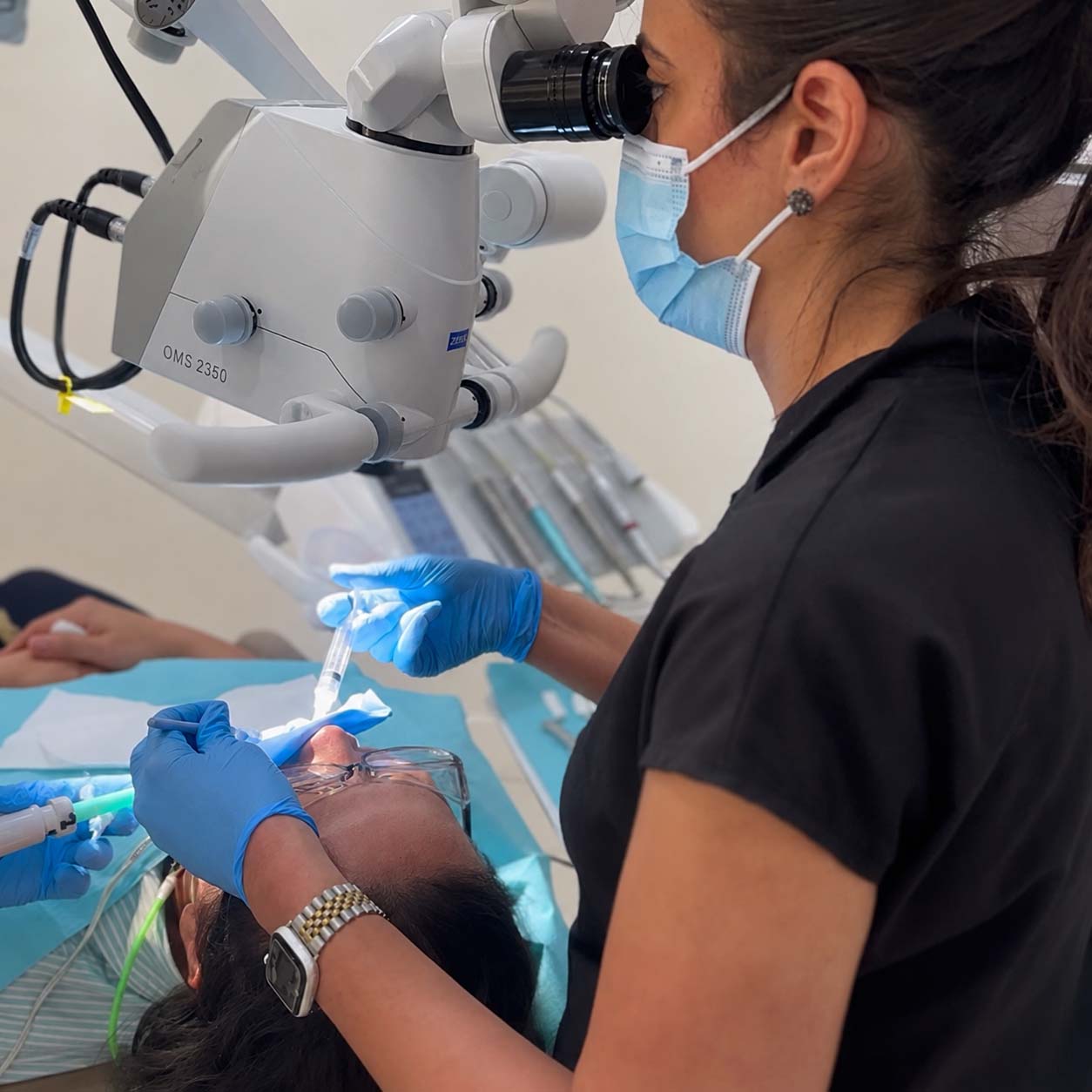
Microscopic root canal treatment is a technique in which a dental microscope is used to provide high magnification and focused illumination during endodontic treatment.
Because root canals are extremely small, certain details may be difficult to see with the naked eye. Magnification allows the dentist to visualize the treatment area in much greater detail, helping with the identification and treatment of complex canal anatomy.
This can be particularly valuable when treating narrow, curved, calcified, or previously treated canals.
Why Is a Dental Microscope Used During Root Canal Treatment?
Improved Visibility
The internal anatomy of a tooth is not always straightforward. Some canals may be very small, hidden, or difficult to access.
A dental microscope can help the dentist identify:
- Tiny canal openings
- Additional or hidden canals
- Calcified canals
- Complex anatomical structures
- Fine cracks or defects
- Previous treatment complications
Better visualization allows the dentist to work with greater control in areas that are difficult to see with the naked eye.
Finding Additional Canals
One of the important goals of root canal treatment is to locate and treat the entire canal system.
Some teeth have additional canals that can be difficult to identify without magnification. If an infected canal remains untreated, bacteria can continue to survive inside the tooth and may contribute to persistent infection.
Microscopic endodontics provides enhanced visualization of the pulp chamber and helps the dentist carefully investigate areas where additional canals may be present.
Greater Treatment Precision
Root canal treatment involves working inside extremely small spaces.
Magnification allows the dentist to perform delicate procedures with improved visual accuracy. This can be especially helpful when dealing with calcified canals, previous root canal fillings, separated instruments, or other treatment complications.
Preserving More Healthy Tooth Structure
Modern endodontics is not only about eliminating infection. It is also about preserving the natural tooth whenever possible.
Improved visualization can support a more controlled and conservative approach, helping the dentist remove only the tooth structure necessary to access and treat the canals.
Preserving sound tooth structure is an important consideration for the long-term function of the tooth.
When Is a Dental Microscope Particularly Useful?
While many routine root canal treatments can be completed without a microscope, magnification becomes especially valuable in challenging cases.
These may include:
- Root canal retreatment
- Previously failed root canal treatment
- Calcified or blocked canals
- Very narrow canals
- Complex root anatomy
- Suspected missed canals
- Separated instruments
- Perforation repair
- Difficult access procedures
- Suspected cracks or fractures
In these situations, enhanced visualization can make a significant difference in how the dentist approaches the treatment.
Combining the Dental Microscope With CBCT Imaging
Modern advanced endodontics may involve combining different technologies to better understand a difficult case.
A CBCT scan can provide three-dimensional information about the tooth and surrounding structures, while the dental microscope provides enhanced visualization during treatment.
When clinically indicated, using these technologies together can help with diagnosis, treatment planning, and the management of complicated root canal anatomy.
However, CBCT is not necessary for every patient. It should be recommended when the additional information is expected to contribute meaningfully to diagnosis or treatment.
Is Root Canal Treatment Under a Microscope Painful?
Using a microscope does not make root canal treatment painful.
The procedure is performed under local anaesthesia, and patient comfort remains an important part of treatment.
The main advantage of the microscope is precision and enhanced visualization, rather than pain control.
The level of discomfort before, during, or after treatment can depend on factors such as the degree of infection, inflammation, the condition of the tooth, and the complexity of the procedure.
Can a Dental Microscope Help Save a Tooth?
A microscope cannot guarantee the success of root canal treatment. The long-term prognosis depends on several factors, including the condition of the tooth, the extent of infection, the quality of previous treatment, the presence of cracks or fractures, and the final restoration.
However, enhanced magnification can be extremely helpful when treating complex cases.
By allowing the dentist to better visualize the internal anatomy, locate difficult canals, and manage treatment complications, microscopic endodontics can support the goal of preserving a natural tooth whenever predictable treatment is possible.
When Should You See an Advanced Endodontic Dentist?
Consider an advanced endodontic assessment if you experience:
- Persistent pain after root canal treatment
- Pain or tenderness when biting
- Recurrent swelling or dental abscess
- Continued symptoms following previous treatment
- A suspected missed canal
- A heavily calcified tooth
- An unusually complex root canal system
- A broken instrument inside a root canal
- A tooth that has been recommended for root canal retreatment
A detailed examination, appropriate imaging, and careful assessment of the tooth can help determine the most suitable treatment option.
Why Preserving Your Natural Tooth Matters
When a natural tooth can be predictably treated and restored, preserving it is often an important goal.
Advanced endodontics combines clinical expertise with modern technology and precise treatment techniques to manage complicated root canal cases while aiming to preserve as much healthy tooth structure as possible.
A dental microscope is more than simply a magnifying device. It provides the enhanced vision and illumination needed to work accurately within the extremely small and complex environment of the root canal system.
For patients requiring complex treatment or retreatment, microscopic root canal treatment can provide an additional level of precision and control.
Frequently Asked Questions
Is microscopic root canal treatment better?
A microscope can provide important advantages, particularly in complex or difficult cases. However, not every root canal requires microscopic treatment. The appropriate approach depends on the anatomy and condition of each individual tooth.
Can a dental microscope find hidden canals?
Magnification can make small or difficult-to-see canals easier to identify. This can be particularly useful when treating molars or teeth with complex anatomy.
Can microscopic treatment be used for root canal retreatment?
Yes. A microscope can be especially useful during retreatment, when the dentist may need to locate missed canals, remove previous filling materials, identify complications, or investigate the reason for persistent symptoms.
Do I need a CBCT scan for my root canal?
Not necessarily. CBCT should be used selectively when three-dimensional imaging can provide information that is important for diagnosis or treatment planning.
Where can I have advanced microscopic root canal treatment in Bahrain?
If you have a difficult root canal case, persistent symptoms, or a previously treated tooth that continues to cause problems, an advanced endodontic consultation can help determine whether microscopic treatment or retreatment is appropriate.
The goal is not simply to perform a root canal—it is to treat the tooth as precisely as possible while giving it the best opportunity for long-term function and preservation.
Book Now
It’s easy and free!